Paver Patio Installer in Sunbury, OH
Custom paver patios, fire pits, and seat walls that turn a bare Sunbury backyard into a space you’ll actually use.
A paver patio is one of the best ways to finish a new-construction backyard — and unlike a poured slab, pavers flex with Ohio’s freeze-thaw ground movement instead of cracking (here’s how pavers compare to concrete and stamped concrete). We design and install custom paver patios across Sunbury and Delaware County, from a simple sitting area to a full outdoor living space with a fire pit, seat walls, and built-in grill station.
Every patio starts with a proper compacted base — the part most people never see and the part that determines whether your patio stays flat for decades. We build to last, with quality pavers from manufacturers you can rely on, and we grade for drainage so water moves away from your home, not toward it. Budgeting your project? See how much a paver patio costs in Sunbury.
Pairing a patio with a deck? We do both, and we’ll design them to work together as one outdoor living space.
Patio work varies a lot by town, because the yards do. We cover the specifics separately for paver patios in Galena, Ohio (big, flat new-construction lots and HOA review) and paver patios in Powell, Ohio (established yards, tight access, and slab replacements) — or see our whole Delaware County, Ohio build area.
Patio contractors in Sunbury, Ohio are not all building the same patio. The finished surface looks similar in every portfolio photo; the difference is underneath it. A patio that stays flat through Ohio freeze-thaw needs a compacted aggregate base of the right depth for the soil, a bedding layer that is screeded rather than dumped, edge restraint that is actually pinned, and polymeric sand that is installed and activated correctly. When you compare patio contractors, ask each one for base depth, compaction method, edge restraint, and drainage plan in writing — those four lines separate a patio that lasts twenty years from one that heaves in three. Ours are on every estimate, and typical numbers are in the Sunbury paver patio cost guide.
What We Build
- Paver patios in a range of styles, colors, and patterns.
- Fire pits & fireplaces to extend your season into the fall.
- Seat walls & retaining walls for usable, finished spaces.
- Walkways & steps connecting patio, deck, and yard.
- Proper base & drainage so it stays flat and dry for years.
The base is the patio
Everything that decides whether a paver patio still looks right in fifteen years happens before a single paver is set. The visible layer is the part you choose; the invisible layers are the part that determines whether you ever think about it again.
The sequence is straightforward and there are no shortcuts in it: excavate down past topsoil and any soft builder fill to ground that will actually carry load, place aggregate base and compact it in layers rather than all at once, screed a bedding layer, set and cut the pavers, lock the perimeter with edge restraint, then sweep and set the joint sand. Skip depth on the base, or compact it in one thick lift instead of several thin ones, and the patio will tell on you the following spring.
Depth is not one number — it depends on your soil and on what the patio has to carry. Much of Delaware County sits on heavy clay that drains slowly and holds water against whatever is built on it, which is exactly the condition that makes base depth and compaction worth paying for here.
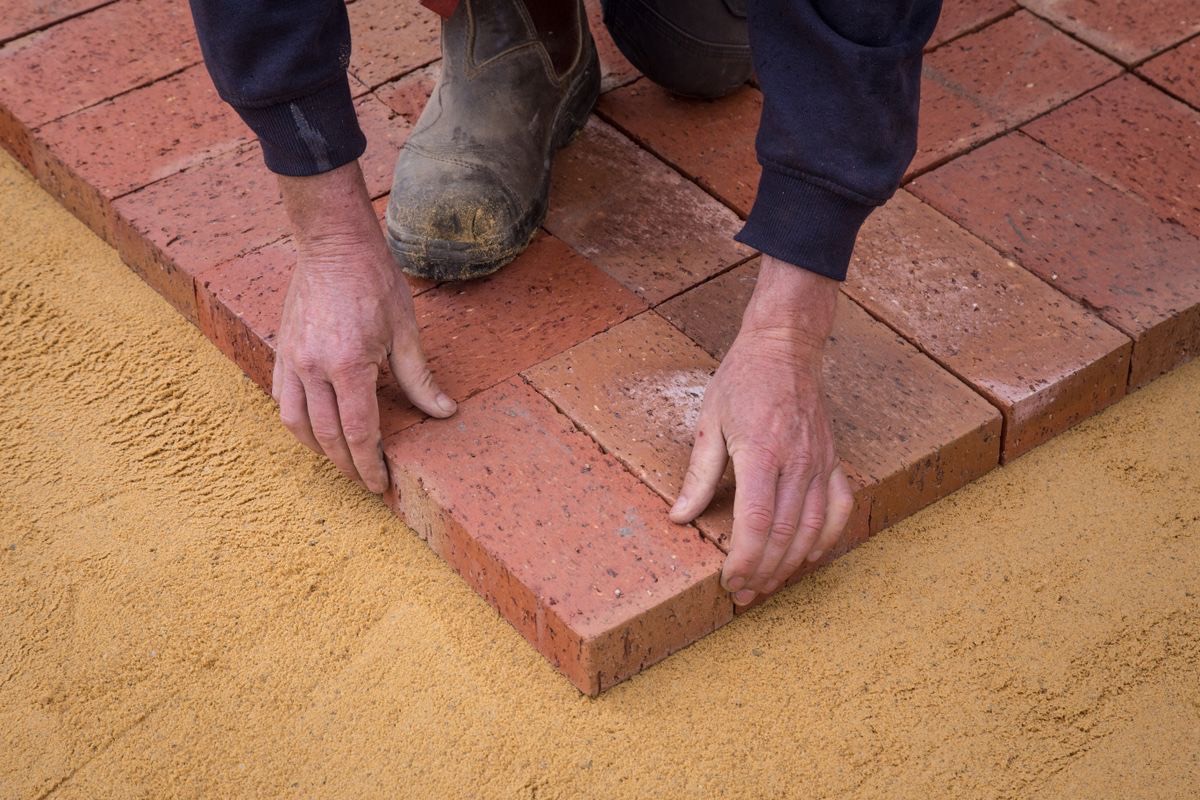
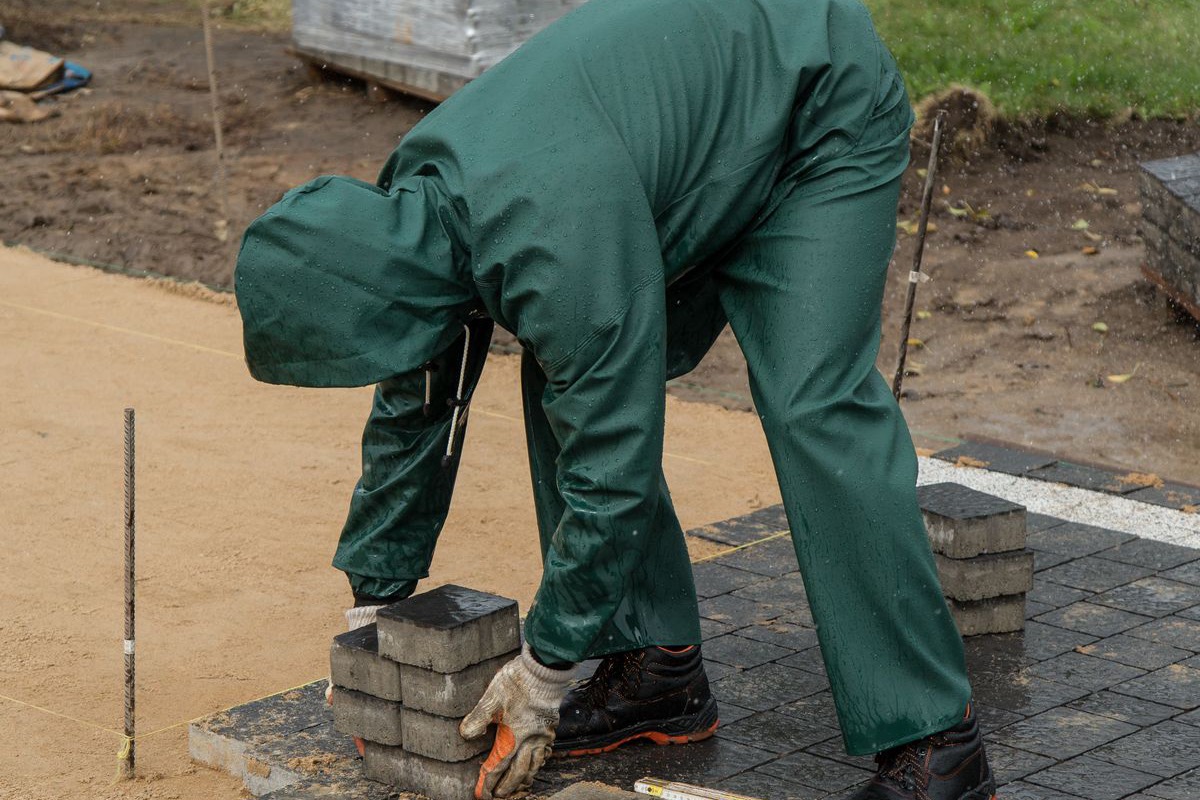
Example photos of the installation steps, not from a specific Sunbury job.
Ohio freeze-thaw, and why pavers beat a slab on it
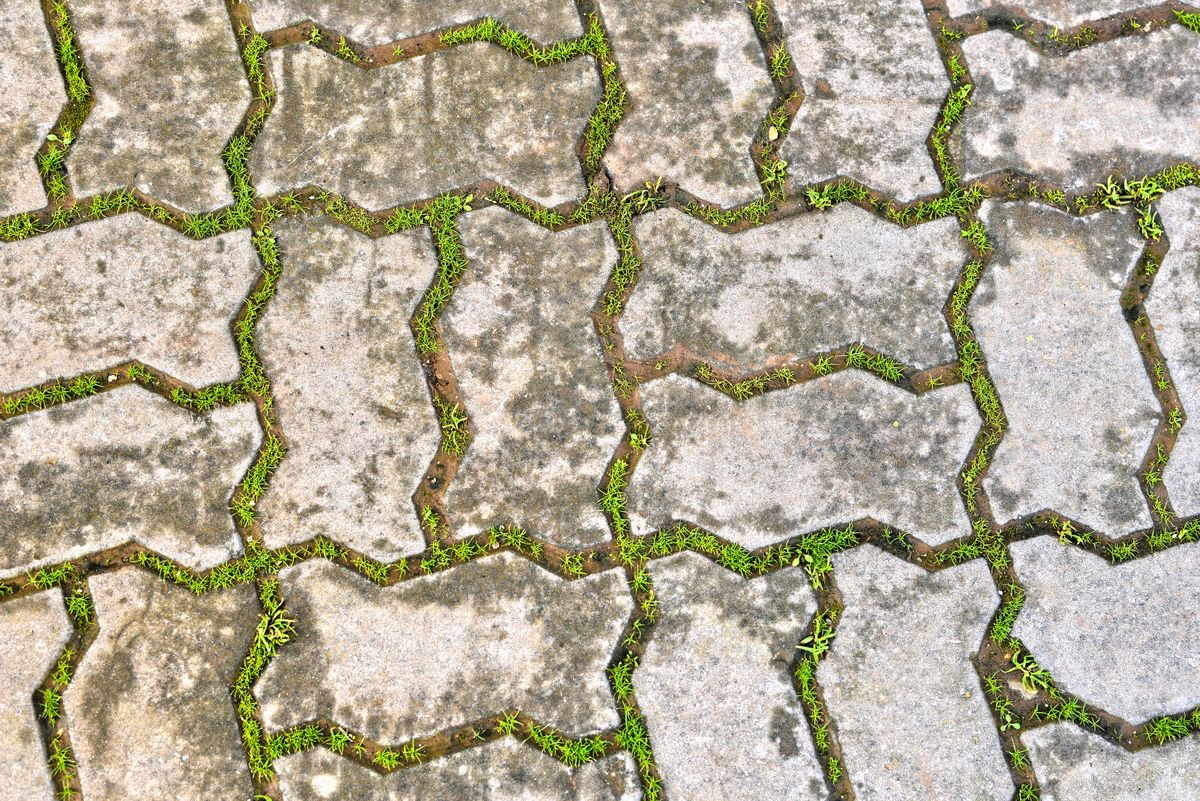
Central Ohio does not freeze once and stay frozen — it crosses the freezing point dozens of times a winter, and wet soil expands every time it does. That repeated lifting is the force that cracks concrete slabs. A paver field handles it differently: it is thousands of small units sitting on a drained, compacted base, so it flexes with the ground instead of resisting it, and any section that does move can be lifted and reset rather than replaced. It is the same physics that decides how deep a deck footing has to go — see deck footings and the Ohio frost line — applied to something that sits on the ground instead of in it.
Sunbury-area yards: what we're usually working with
Patio work varies more by yard than by town, and around Sunbury the yards fall into two clear groups.
- New-construction lots — the Pulte and production-builder communities around Sunbury and Galena, like Eagle Creek and Northstar. These are open, flat, and easy to access, which keeps cost down. What they need attention on is fill: much of the yard is disturbed builder soil that has not finished settling, and downspouts often discharge right where the patio wants to go. Both are solvable, but only if they are dealt with before the base goes in, not after.
- Established yards — older Sunbury and Delaware County homes, plus the mature neighborhoods in Powell. Here the grade has long since settled and the challenges are access for equipment and materials, tree roots, and existing concrete that may or may not be worth keeping. Sunbury Meadows is typical: good bones, tighter working room.
Drainage: where the water goes
A patio changes how your yard sheds water, and that is worth getting right the first time. The surface is pitched to move water away from the house rather than toward it, the base is built to drain instead of holding a reservoir under the pavers, and downspouts that used to discharge onto open lawn get accounted for rather than buried. On the flat lots common around Sunbury there is often less natural fall to work with than a homeowner expects, which makes the grading plan part of the design rather than an afterthought.
Patio, deck, or both — start with the door
The most useful question in this whole decision is not aesthetic, it is dimensional: how far is it from your back door threshold to finished grade? A short drop favors a patio, which sits on the ground and needs no guardrail. A tall drop favors a deck, because a patio at that height means either a long run of steps or a lot of fill. Many of the best backyards around here end up with both — a deck at door level stepping down onto a patio for the fire pit and seating.
We build both, so there is no thumb on the scale. Our deck vs. paver patio guide works through door height, slope, cost, permits, and twenty-year upkeep side by side, and full outdoor living designs covers combining them.
Zoning, HOA, and what applies to a patio
An at-grade patio is treated differently from a deck, but "no building permit" does not mean "no rules." Zoning setbacks are set by your township rather than the county, and some townships also limit how much of a lot can be hard surface — our deck permits by township in Delaware County page covers how Berkshire, Genoa, Orange, and Liberty each handle it. Anything attached or covered changes the answer, so a roofed patio is a different conversation from an open one.
In the newer Sunbury and Galena subdivisions there is a third approval that catches people out: HOA architectural review, which runs on its own schedule and does apply to patios, including paver color and material. We confirm all of it for your specific lot before anything is ordered.
Choosing the paver
Once the base and the layout are settled, the paver itself is the fun part and the reversible part. Concrete pavers give you the widest range of shapes, colors, and price points; natural stone reads differently underfoot and ages differently. Our paver patio materials guide compares concrete pavers against natural stone for a Central Ohio patio, and countywide patio cost ranges shows how the choice moves the number.
Why Choose Sunbury Decks & Patios
We’re local to Sunbury and Delaware County, fully licensed and insured, and we pull the permits for you. You’ll get a clear written design estimate before we start and a clean property when we finish.
Paver Patios — Questions, Answered
How do I choose between patio contractors in Sunbury, Ohio?
Compare what is under the pavers, not the pavers. Ask each contractor for the base depth, how it is compacted, what edge restraint is used, and how water will leave the patio — in writing. Then compare warranty terms on settling specifically, since that is how a paver patio fails in Delaware County soil. Portfolio photos all look the same on day one; the base decides what year five looks like.
How much does a paver patio cost in Sunbury?
Paver patios in the Columbus/Delaware County area commonly run about $10–$17 per square foot for a standard install, and more for detailed designs with fire features, seat walls, or premium pavers. We provide a free written estimate for your specific layout.
Pavers or a concrete slab — which is better?
For Ohio’s freeze-thaw climate, pavers are often the better long-term choice: if the ground shifts, individual pavers can be re-leveled, whereas a poured slab tends to crack. Pavers also offer far more design options.
Do paver patios need a permit?
An at-grade patio often has different requirements than a deck, but zoning setbacks and HOA rules still apply, and any attached structure (like a covered patio) may need a permit. We confirm the requirements for your lot before we start.
Can you build a patio and a deck together?
Yes — combining a raised deck with a ground-level paver patio is one of the most popular outdoor-living designs, and we handle the whole project as one.
Do paver patios sink or settle in Ohio?
A properly built one does not, and when one does the cause is almost always the base rather than the pavers. Ohio ground moves every winter, so a patio set on thin or poorly compacted base rides that movement. Built correctly — excavated to solid ground, aggregate base placed and compacted in layers, a screeded bedding layer, and edge restraint holding the field together — the patio moves as one piece instead of settling in patches. This is also the quiet advantage over concrete: if a section ever does move, individual pavers can be lifted and reset, which a cracked slab cannot.
Can you build a paver patio over an existing concrete slab?
Sometimes, and it depends entirely on the slab. A sound, well-drained slab with no significant cracking or heaving can be used as a base. A slab that has cracked, tipped, or lifted is telling you the ground under it has moved, and laying pavers on top just puts a new surface on the same problem — in that case removing it and building a proper base is the honest answer. We tell you which one you have before quoting it.
What time of year can a paver patio be installed in Ohio?
Patio installation runs a longer season than most people assume. Unlike a concrete pour, pavers do not need to cure, so the limiting factor is frozen or saturated ground rather than air temperature — which means late fall installs are often very doable while a slab would not be. Spring is the busiest booking window in Central Ohio, so scheduling outside it is usually the cheapest decision available.
Do I need a permit or HOA approval for a paver patio in Delaware County?
An at-grade paver patio is treated differently from a deck, but zoning still applies — your township sets setbacks and, in some places, limits on how much of a lot can be hard surface. Anything attached or covered can change the answer. If you are in a newer Sunbury or Galena subdivision, HOA architectural review is a separate approval on its own schedule and it does apply to patios. We confirm the requirements for your specific lot before work starts.
How long does a paver patio take to build?
Most residential patios are a matter of days on site once the design and approvals are settled, with excavation and base prep taking the larger share of that time and the paver laying going faster than people expect. The longer part of the calendar is usually in front of the build — design, any HOA review, and material availability for the paver you choose.
Our Other Services
Serving Sunbury, Galena, Delaware, Powell, Lewis Center and all of Delaware County, Ohio.
Let’s Design Your Backyard Patio
Free, no-obligation design quotes for homeowners in Sunbury, Ohio and Delaware County.